In the game, there are numerous parameters influencing the Sultan’s growth, but the desire to improve each of them “here and now” in the current tournament (or even without it) will scatter all efforts. Yes, the Sultan will not occupy the last places in the rankings, but will be just an average player without entering the top rankings. The ability to accumulate and spend at the right moment should be at the core of the strategy in this game. The exception is for those who can afford to correct mistakes with money (donate to the game).
Where to start? We assume that the training stage (within the game itself) has already been completed, and if the dear reader has stumbled upon this material, it means they are in search of an optimal tactic and strategy for the Sultan’s rapid growth. Growing the Sultan means increasing the value of his reputation, but not everything is so straightforward because developers have introduced the concept of “damage,” which we will return to shortly, but for now, let’s talk about reputation.
Sultan’s Reputation is the total sum of the skills of all advisors + heirs. In other words, to make the Sultan grow, one needs to skillfully and correctly cultivate his advisors, concubines, and heirs.
Reputation is the sum of skills in tactics, politics, culture, and science.
Tactics – power and combat damage in battles
Politics – the amount of provisions
Science – the amount of gold
Culture – the number of soldiers
All of this revolves around advisors, and we’ll examine them in more detail.
Advisors
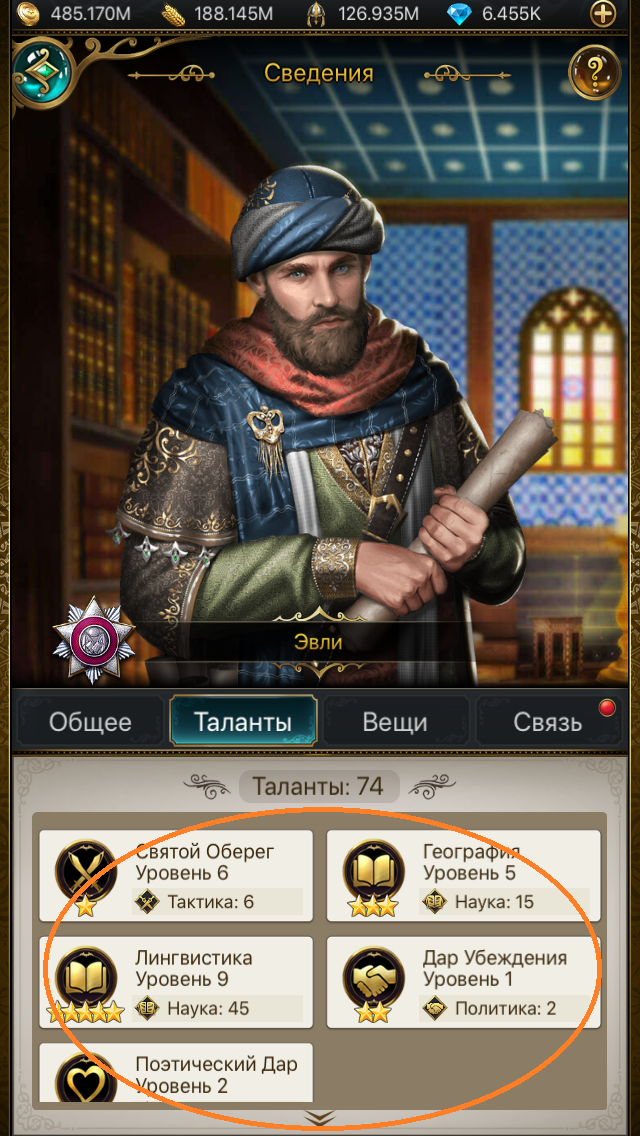
Talents are practically the most important aspect of an advisor, and based on the quantity of talents, we will select advisors for leveling up in the first place!
Straight to practice. Learn to understand what the quantity of talents means. Each advisor has 4 skills: tactics, science, politics, and culture. The number of stars next to the skill is the quantity of talents, and the skill level is the multiplier for stars.
Example. In the image, we see that the advisor Evli has 2 stars at level 1 politics, so we have politics for him as 1×2 = 2 talents.
The same calculation applies to all others. Evli’s tactics now (see the image) are 6×1 = 6 talents.
IMPORTANT! If an advisor has 2 indicators within one skill, on our example, it’s science: 5 stars of linguistics and 3 stars of geography, then talents are summed up. Thus, for Evli (see the image), we currently have 9×5+5×3 = 60 talents in science.
So, it is necessary to review the talents of each advisor, preferably not only those in stock but also considering those that will be given in the future or can be bought (for whom it is relevant) and choose a team literally from 3-4 advisors that will level up first and be the strongest.
There must be 1-2 strong tactics, and after them, resource advisors should be brought up.
Level up talents with tokens and experience.
Take tokens from rewards at events (rewards tab) and buy them in stores for points from tasks.
Take experience in the academy and in knowledge almanacs, which also come as prizes and gifts in various tasks and are available in stores.
Many are afraid to invest tokens in advisors when the skill has 5 stars because the chance of improvement is only 20%. Don’t be afraid of this; invest tokens primarily in skills with 5-3 stars! What you get in the end will pleasantly surprise you 🙂
How and when to invest tokens correctly is described below and in this guide for the Sultan.

In the “Items” tab, you can level up an advisor for foliants, tomes, books, and booklets, which, like everything else, need to be earned from various game competitions.
Вот текст на английском:
“`html
All these books add skills as much as is written on them. In other words, a tome for 5000 will add exactly 5000 skills.
IMPORTANT! When leveling up advisors, it should be noted that the advisor’s level and the quantity of their talents are multipliers in the strength (damage) formula, and books, tomes, etc., are just additives. Don’t make big bets on the additive! This is a mistake made by all beginners who endlessly pour books into advisors without noticeable returns.
The most effective way to level up is with tokens, followed by the advisor’s level, and various books and foliants become less and less significant with the growth of the advisor’s strength. I recommend saving them and using them in ranking events.

The “Relations” tab shows the concubine with whom the advisor is associated. Each visit to this concubine accumulates experience, which transforms into an increase in the advisor’s skills.
The more charming the concubine, the more experience she gains during the visit, and the greater the amount of skills can be raised for the advisor associated with her.
And the level of closeness of the concubine expands the possibility of choosing which skill to increase for the associated advisor.
In addition, in the drawing, reading, and music classes, concubines receive knowledge stones, which increase the bonus level to the skills of the associated advisor.

In the “General” tab, you can observe the values of your advisor’s skills, and right there is the leveling up of their level.
IMPORTANT! When the “+10 levels” checkbox is enabled, there is no chance of getting an additional bonus when leveling up the advisor.
Level up concubines with rings and earrings, which are obtained in sufficient quantities by participating in various game events.
Experienced players recommend leveling up only one concubine, so she will look decent in drawing, reading, and music classes.
Making a choice of which concubine to level up is no less important than choosing which advisors will be the main characters. It is advisable to choose a concubine associated with one of these advisors.
Children usually do not pose any difficulties since handling them is just training and giving in marriage, which adds reputation according to the child’s ability.
Damage. This is a very important value that determines the strength of the advisor, and it is not obvious to beginners. It often happens that a person levels up reputation, and damage almost stays in place, so the alliance member “takes a back seat” in battles, expeditions, hunting, and in the fortress.
You can easily find out your damage: go to the alliance, then to the expedition, then click to add an advisor, and they will all line up according to their damage.
Otherwise, damage is determined by the formula:
S = L x T x 5000 + R
where:
S – the desired damage value;
L – advisor’s level;
T – quantity of tactics talents;
5000 – coefficient invented by the developers;
R – advisor’s tactics value (see the “General” tab);
Analysis of this formula does not require knowledge of higher mathematics and unambiguously gives an answer to the question: “why are books, tomes, booklets, and foliants less effective than tokens?” – because all your tactics books poured into the advisor will give only one term of this formula, which, in comparison with the first part, is a negligible quantity.
;
When to use tokens, gold, books?
In the rewards tab, you need to keep an eye on what exactly is being given now and remember that there is often an intersection of rewards, for example, rewards for reputation very often come with rewards for using gold and tokens. Try to wait for worthwhile events and spend these valuable resources only during such events.
It should be remembered that in addition to rewards, there are also ranking events; it is very good if the ranking event for gold coincides with the reward event for gold – you get an increased amount of prizes.
This advice applies to all game consumables because they are used in one way or another to level up your advisors and the sultan in general. Only a well-thought-out strategy of accumulating resources and using them precisely in the right periods is the key to success in this game.
“`